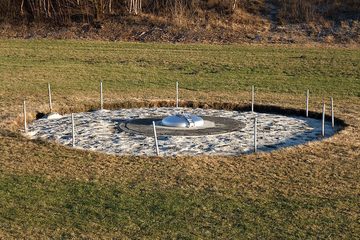
On 5 November 2026 the Ministry of Agriculture announced a proposal to raise charges for groundwater abstraction, with the revenue to go to water supply and sewerage development, while Motoristé sobě, a government party, wanted to discuss it further with ANO and SPD at a coalition council.
The proposal to raise charges for groundwater abstraction is a legislative change announced in a press release on 5 November 2026 by the Ministry of Agriculture.[1][2] According to the ministry, the revenue from the higher charges is to serve the development of water supply and sewerage systems, in particular the interconnection of water supply networks, the construction of wastewater treatment plants and the preparation of new water sources for adapting to climate change.[1]
“After the regional roads, this is another attack by the government of Andrej Babiš (ANO) on the regions.”
Level of the charges
Groundwater currently costs two koruna per thousand litres, while surface water costs between 5.20 and nine koruna depending on the river basin and, according to the ministry, is used by more than half of the population.[1][2] According to Seznam Zprávy, the charges are to rise from two koruna for households and three koruna for businesses to seven koruna per cubic metre.[4] Other sources state that the proposed increase means a rise in the price of groundwater of five koruna per thousand litres, that is 0.005 koruna per litre.[1][2][3] Abstraction of up to 6,000 cubic metres a year, typical for households with a well and for municipalities of up to about 250 inhabitants with boreholes, remains exempt from the charge.[1][2]
Distribution of revenue and the regions' response
The proposal also changes who receives the revenue from the charges. So far it has been shared between the Státní fond životního prostředí and the regions; from April 2027, under an amendment tabled by deputies, it is to go directly to the Ministry of Agriculture's budget chapter.[2] According to ČTK, the Central Bohemian Region receives 70 million koruna a year this way, of which ten million goes to the Emergency Fund for Water Quality Protection and the rest to water supply, sewerage and drinking water provision.[1][2] The region did not agree with the change.[1][2] The Agriculture Committee of the Chamber of Deputies therefore asked the minister of agriculture to prepare a solution that would compensate the regions for the loss of this money.[1][2]
The Agricultural Association of the Czech Republic asked for an exemption for farmers and food producers. The association said that raising charges for farmers at a time of drought and rising costs makes no sense.[1][2] The director of the Association of Water Supply and Sewerage Operators of the Czech Republic (SOVAK), Vilém Žák, had earlier, according to ČTK, called for aligning the prices of groundwater and surface water, while adding that the increase alone makes no sense unless the state uses the money to strengthen water infrastructure, in particular by building reservoirs and interconnecting water supply networks.[1]
Proceedings in the Chamber of Deputies and in the coalition
The change comes through a deputies' amendment to a bill on plant health care, to which, according to Ekolist, it is not related in substance.[2][4] The Chamber of Deputies was to vote on the proposal on Friday 6 November 2026, but no vote took place after a power outage shortened the deputies' sitting time.[3][4]
The Christian Democrats had opposed the approach earlier, and on 5 November 2026 the Starostové criticised the plan at a press conference in the Chamber of Deputies.[2] STAN chairman Vít Rakušan said: "After the regional roads, this is another attack by the government of Andrej Babiš (ANO) on the regions."[2] STAN deputy Jana Krutáková said that for the South Moravian Region it means tens of millions of koruna and that the proposal does not guarantee that the money transferred to the Ministry of Agriculture's chapter will be used exclusively for water management.[2]
In the CNN Prima News discussion programme, the price increase was defended by coalition deputies Jana Murová (ANO) and Radek Koten (SPD), who said it would not be passed on to end customers' prices.[3] Opposition deputies Jan Skopeček and Pavla Pivoňka Vaňková, by contrast, pointed out that every region would lose tens of millions of koruna for water infrastructure.[3]
Filip Turek, a Motoristé sobě deputy and the government commissioner for climate policy and the Green Deal, said on Nova television on Saturday 7 November 2026 that Motoristé sobě wanted to discuss the increase further with their coalition partners ANO and SPD at the coalition council on Monday.[3][4] According to Seznam Zprávy, Motoristé sobě dislike both the price increase itself and the distribution of the revenue, most of which is now to go to the Ministry of Agriculture.[4] The leader of the Czech Pirate Party, Zdeněk Hřib, recalled that Motoristé sobě had earlier agreed that the higher charges would raise the Ministry of Agriculture's budget by two billion koruna.[4]
The leader of Motoristé sobě Petr Macinka, by contrast, said on the programme Partie Terezie Tománkové that the proposal to raise the charges had already passed through the government coalition's talks.[3] According to the sources, the statements of the two Motoristé sobě politicians thus contradict each other: Turek spoke of a discussion planned at the coalition council on Monday, while Macinka claimed that the coalition had already discussed the proposal.[3]
Approval of the higher charge in the Chamber of Deputies
The Chamber of Deputies approved the increase in the groundwater abstraction charge as part of the amendment to the plant health care act, into which it inserted an amendment by deputy Karel Tureček (ANO). The charge for abstraction for drinking purposes is to rise from two to seven koruna per cubic metre from April 2027, and for other uses from three to seven koruna.[5] The draft state budget for next year counts on the revenue.[5]
Tureček's proposal removes the part of the revenue intended for the regions.
Chronology
- — The Ministry of Agriculture proposed raising fees for groundwater extraction, with the revenue meant to fund the development of water and sewage systems, while the coalition Motorists party wants to discuss the proposal with ANO and SPD at the coalition council. ČTK / České noviny Ekolist.cz
Sources
- Ministerstvo zemědělství plánuje skokové zdražení podzemních vod
- Kraje mají přijít o poplatky za podzemní vody, i Mze je použije na vodní stavby
- Motoristé chtějí v koalici probrat zdražení čerpání podzemních vod
- Motoristé chtějí v koalici probrat zdražení poplatků za čerpání podzemních vod
- Sněmovna schválila růst poplatků za podzemní vodu ze dvou na sedm Kč za m3