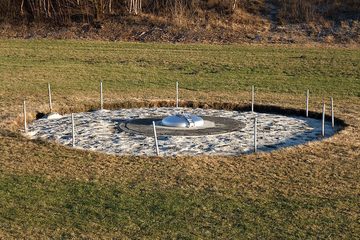
On 5 November 2026 the Ministry of Agriculture announced a proposal to raise fees for groundwater abstraction, with the proceeds to go to water supply and sewerage development, while the governing Motoristé wanted to discuss it first with ANO and SPD at a coalition council.
The proposal to raise groundwater abstraction fees is a legislative change announced in a press release on 5 November 2026 by the Ministry of Agriculture.[1][2] According to the ministry, the proceeds from the higher fees are to serve the development of water supply and sewerage systems, in particular the interconnection of water supply networks, the construction of wastewater treatment plants and the preparation of new water sources for adaptation to climate change.[1]
“After the regional roads, this is another attack by the government of Andrej Babiš (ANO) on the regions.”
Level of the fees
Groundwater currently costs two crowns per thousand litres, while surface water costs from 5.20 to nine crowns depending on the river basin; according to the ministry, more than half of the population uses it.[1][2] According to Seznam Zprávy, the fees are to rise from two crowns for households and three crowns for businesses to seven crowns per cubic metre.[4] Other sources say that the proposed increase means a rise in the price of groundwater of five crowns per thousand litres, that is 0.005 crowns per litre.[1][2][3] Abstraction of up to six thousand cubic metres a year, typical for households with a well and for municipalities of up to about 250 inhabitants with boreholes, remains exempt from the fee.[1][2]
Division of the proceeds and the reaction of the regions
The proposal also changes who receives the proceeds from the fees. So far they have been shared by the State Environmental Fund and the regions; from April 2027, under an amending proposal by MPs, they would go directly to the Ministry of Agriculture's budget chapter.[2] According to the Czech News Agency, the Central Bohemian Region currently receives 70 million crowns a year this way, of which ten million go to the Emergency Fund for the Protection of Water Quality and the rest to water supply, sewerage and drinking water provision.[1][2] The region did not agree with the change.[1][2] The Agriculture Committee of the Chamber of Deputies therefore asked the minister of agriculture to prepare a solution that would compensate the regions for the loss of this money.[1][2]
The Agricultural Union of the Czech Republic asked for an exemption for farmers and food producers. The union said that raising fees for farmers at a time of drought and rising costs makes no sense.[1][2] According to the Czech News Agency, Vilém Žák, director of the Association of the Water Supply and Sewerage Sector of the Czech Republic (SOVAK), had already earlier called for aligning the prices of groundwater and surface water, but added that a price rise alone makes no sense if the state does not use the money to strengthen water infrastructure, especially to build reservoirs and interconnect water supply networks.[1]
Handling in the Chamber of Deputies and in the coalition
The change comes in an MPs' amending proposal to an amendment of the plant health care act, with which, according to Ekolist, it is unrelated in substance.[2][4] The Chamber of Deputies was due to vote on the proposal on Friday 6 November 2026, but no vote took place after a power outage cut short the MPs' sitting.[3][4]
The Christian Democrats had opposed the approach earlier, and on 5 November 2026 Starostové criticised the plan at a press conference in the Chamber of Deputies.[2] STAN chairman Vít Rakušan said: "After the regional roads, this is another attack by the government of Andrej Babiš (ANO) on the regions."[2] STAN MP Jana Krutáková said that for the South Moravian Region it means tens of millions of crowns and that the proposal does not guarantee that the money moved to the Ministry of Agriculture's chapter will be used solely for water management.[2]
In a discussion programme on CNN Prima News, the coalition MPs Jana Murová (ANO) and Radek Koten (SPD) defended the price rise, saying it would not be passed on to end customers' prices.[3] Opposition MPs Jan Skopeček and Pavla Pivoňka Vaňková, by contrast, pointed out that every region would lose tens of millions of crowns for water supply infrastructure.[3]
Filip Turek, an MP for Motoristé and the government's commissioner for climate policy and the Green Deal, said on Nova television on Saturday 7 November 2026 that Motoristé wanted to discuss the price rise further with their coalition partners ANO and SPD at the coalition council on Monday.[3][4] According to Seznam Zprávy, Motoristé dislike both the price rise itself and the division of the proceeds, most of which is to go to the Ministry of Agriculture.[4] Zdeněk Hřib, chairman of the Czech Pirate Party, recalled that Motoristé had already earlier agreed that the increase in fees would raise the Ministry of Agriculture's budget by two billion crowns.[4]
Motoristé chairman Petr Macinka, by contrast, said in the programme Partie Terezie Tománkové that the proposal to raise fees had already passed through the governing coalition's negotiations.[3] The statements of the two Motoristé politicians thus contradict each other, according to the sources: Turek spoke of a planned discussion at the coalition council on Monday, while Macinka claimed that the coalition had already discussed the proposal.[3]
Chronology
- — The Ministry of Agriculture proposed raising fees for groundwater extraction, with the revenue meant to fund the development of water and sewage systems, while the coalition Motorists party wants to discuss the proposal with ANO and SPD at the coalition council. ČTK / České noviny Ekolist.cz
Sources
- ČTK / České noviny — 5 November 2026
- Ekolist.cz — 5 November 2026
- ČTK / České noviny — 8 November 2026
- Seznam Zprávy — 8 November 2026