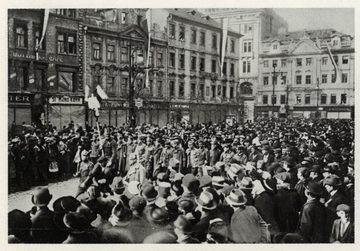
The origin of Czechoslovakia refers to the events of 28 October 1918, when an independent Czechoslovak state came into being at the end of the First World War. The Vojenský historický ústav Praha marks this date as the day the republic was founded.[1]
The road to independence
For centuries Slovakia belonged to the Kingdom of Hungary, while in 1526 Bohemia joined Austria and Hungary in a single state, with the consent of its estates and under the Turkish threat. After the defeat of the Bohemian estates' uprising in 1620, and above all from the 18th century, the Habsburgs pursued a centralising policy that endangered Czech national identity. According to the institute, in the Hungarian part of the monarchy the national identity of the Slovaks was deliberately suppressed.[1]
At the start of the 20th century the Czechs were a nation of almost seven million with an advanced culture and economy, but without a state of their own. At the beginning of the war the Western powers knew little about the Czechs and their demands, and almost nothing about the roughly two million Slovaks. Many Entente politicians regarded the idea of a Czechoslovak state as unrealistic.[1]
For much of the war the preservation of Austria-Hungary was also considered, especially if it were to break away from its German ally and conclude a separate peace. The leaders of the foreign resistance argued, by contrast, that only the dissolution of the monarchy could secure the free development of the oppressed nations.[1]
The foreign resistance and the Legions
Tomáš Garrigue Masaryk set the creation of an independent army, politically subordinate to the leadership of the resistance, as the first aim of the foreign resistance. He expected a long war in which the Allies would need every unit, and he reasoned that if they recognised the Czechoslovak army, they would recognise the Czechoslovak cause as well. At the start of the war the first units of Czech and Slovak volunteers were formed from compatriots abroad, chiefly in Russia and also in France, always as part of the local armies. The Legions were reinforced by compatriots from the USA and above all by prisoners taken at the front. Separate Legions arose in Russia, Italy and France, and according to the institute about 100,000 men are estimated to have served in them during the war.[1]
The largest part of the Czechoslovak forces operated in Russia, where about 70,000 men passed through them during the war. The rifle brigade there distinguished itself on 2 July 1917 in the Battle of Zborov in Ukraine. On a 6.5 km stretch it broke through the enemy defences, advanced to a depth of 5 km and took 3,200 prisoners and a quantity of weapons, losing 190 dead and about 800 wounded.[1]
Founding and recognition of the state
The state came into being on 28 October 1918 as the fulfilment of the Czechs' and Slovaks' longing for independence. Towards the end of the war this demand was expressed in extensive demonstrations and rallies of the Czech population and in steps taken by its political representatives, which led to the break with Austria-Hungary and to the declaration of independence.[1]
The founding of the state took place without bloodshed. It was eased by the power vacuum in central Europe after the defeat and collapse of Austria-Hungary and Germany and after the revolutionary upheavals in Russia. The victorious powers had, moreover, recognised the new state even before it came into being, thanks to the foreign resistance, whose leading figures were Tomáš Garrigue Masaryk, Milan Rastislav Štefánik and Edvard Beneš. According to the institute, the key to this recognition was the fighting of the Czechoslovak Legions during the First World War.[1]