The South Bohemian Region declared a state of drought for its entire territory on 6 October 2026; the Husinecká přehrada in the Prachatice area is almost empty.
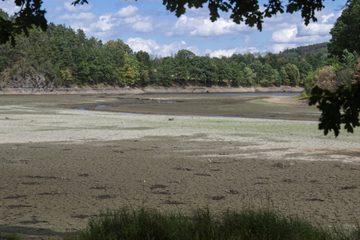
South Bohemian Region declared a state of drought for its entire territory on 6 October 2026. The region has been suffering from drought for several weeks, and because of a long-term lack of rainfall, millions of cubic metres of water are missing in reservoirs, ponds and rivers.[2] The declaration allows, among other things, faster handling of outflows from reservoirs: under normal conditions various institutions, such as the anglers' union, would have to comment on it and the procedure would take several days, whereas during a state of drought the river basin authority can proceed immediately in cooperation with the region.[1][2]
Husinecká přehrada
According to Jiří Baloun, director of the Horní Vltava plant of Povodí Vltavy, the Husinecká přehrada on the Blanice river became the first Czech dam to almost dry up. 30,000 cubic metres of water remained in the storage space, that is 1.3 percent of the usual volume, and the water level had dropped seven metres below normal.[1] Povodí Vltavy will therefore begin releasing only the inflow and will stop using water to improve the flow of the Blanice. This is to happen once the minimum operating level of 515.33 metres above sea level is reached, which Baloun estimated at about two days. In his words, this has not happened during his time there.[1]
The Husinec waterworks was built between 1934 and 1939 about three kilometres above the town of Husinec. Originally it served for flood protection and for retaining water in dry periods. Since 1962 it has been a drinking-water reservoir for the town of Prachatice. The masonry dam is 197 metres long and the reservoir floods 61 hectares.[1]
Římov reservoir
Povodí Vltavy is preventively reducing the outflow from the Římov reservoir in the České Budějovice area from about 500 to 400 litres per second; the inflow is approximately 200 litres per second. The reservoir holds over 16 million cubic metres of water, that is 55 percent of capacity, and supplies drinking water to more than 360,000 inhabitants of the region.[2] Regional governor Martin Kuba (Naše Česko) said after a meeting of the crisis staff that the smaller volume of water makes its treatment more difficult because cyanobacteria multiply more in the reservoir. The South Bohemian Water Supply Association therefore put back into operation the water treatment plant on the Otava river in Písek, which had interrupted operation this year because of the low level of the river. The governor also asked residents not to waste water.[2]
Related articles: Husinecká přehrada, Povodí Vltavy, South Bohemian Region
Impact of drought on autumn pond harvests
According to the Czech News Agency, the drought is affecting the autumn pond harvests in the South Bohemian Region. More than half of the water has evaporated from the ponds, water is also lacking in the holding tanks and inflows are drying up. Fishermen therefore transfer water and pump it between ponds and holding tanks. The harvests of large ponds are being postponed to the turn of November and December so that the Christmas carp spend as little time as possible in the holding tanks.[3][4]
Vladimír Kaiser, managing director of Rybářství Hluboká, said that the Hluboká fishermen have cancelled the ceremonial harvests and are adjusting the schedule as they go. The harvest of the Munický pond, which covers more than one hundred hectares, was postponed to 3 and 4 December 2026 because the pond lies above the holding tanks and the fishermen are trying to hold the water in it for as long as possible.[3][4]
Vladimír Kukačka, production director of Rybářství Třeboň, said that they stopped taking measurements roughly two weeks before the report was published. At that time 45 percent of the water was missing from a total volume of 75 million cubic metres. The harvest of Rožmberk, the largest Czech pond, is not taking place in 2026. It will be replaced by the Days with the Třeboň Fishermen at the holding tanks on Friday and Saturday 16 and 17 October 2026. The harvests of the Záblatský pond and Velký Tisý are being prepared for the end of November. The fishermen do not expect to harvest the Horusický, Dvořiště and Bošilecký ponds in 2026.[3][4]
Around Nové Hrady, a third of the water remained in some ponds and the fishermen are using pumps. Lubomír Zvonař, director of Rybářství Nové Hrady, said that in 46 years on the spot he had not experienced inflows and streams drying up and water running short for the holding tanks, not even in the dry years 1984 and 1985. The harvest of the Byňovský pond was planned for 21 October 2026.[3][4]
Husinecká přehrada reaching its minimum operating level on 8 October 2026
On 8 October 2026 the Husinecká přehrada reached its minimum operating level of 515.33 metres above sea level, seven metres below the normal level, and began releasing only as much water as flows into it. According to Jiří Baloun, director of the Horní Vltava plant of Povodí Vltavy, the storage space, whose volume exceeded two million cubic metres, has been exhausted. The part intended for permanent retention of water remained full. The reservoir previously released roughly 400 litres per second; now about half that amount flows into the Blanice.[5]
The height of the dam crest above the valley is 27.20 metres, a road from Husinec to Prachatice runs over the dam, and the backwater of the reservoir is 3.5 kilometres long.[5]
The Římov dam, which supplies drinking water to a large part of the region, was 54 percent full, according to the Czech News Agency, and Povodí Vltavy reduced its outflow as a precaution. The Hněvkovice and Kořensko reservoirs, which are important for cooling the Temelín Nuclear Power Station, were 88 and 98 percent full.[5] Petr Kubala, director-general of Povodí Vltavy, said that all reservoirs supplying drinking water are sufficiently full and that supply restrictions are not expected. Povodí Ohře has been reducing the outflow from the Březová Reservoir from 170 to 150 litres per second since 8 October 2026.[6]
Parameters of the Husinecká přehrada
The Husinecká přehrada on the Blanice has a masonry dam 197 metres long, and the flooded area of the reservoir is 61 hectares.[5]
The dried-out storage space of the Husinecká přehrada
On 8 October 2026 the Husinecká přehrada on the Blanice reached its lowest operating level of 515.33 metres above sea level, which is seven metres less than usual.[5] The storage space of more than two million cubic metres was used up, and the reservoir began releasing only as much water as flows into it.[5] It had been releasing roughly 400 litres per second, and now about half that amount flows into the Blanice.[5] This was reported by Jiří Baloun, director of the Horní Vltava plant of Povodí Vltavy.[5]
Povodí Vltavy also reduced the outflow from the Římov reservoir as a precaution; it was 54 percent full.[5] The Hněvkovice and Kořensko reservoirs, important for cooling the Temelín Nuclear Power Station, were 88 and 98 percent full.[5] Petr Kubala, director-general of Povodí Vltavy, said that all reservoirs for drinking water supply are sufficiently full and that restrictions on supply are not expected.[6] Povodí Ohře has reduced the outflow from the Březová Reservoir from 170 to 150 litres per second since Thursday.[6]
Emptying of the storage space of the Husinecká přehrada
On 8 October 2026 the Husinecká přehrada on the Blanice reached its lowest operating level of 515.33 metres above sea level, seven metres below the normal level, and began releasing only as much water as flows into it. The storage space of more than two million cubic metres was used up; according to the Czech News Agency, it was the first dam in the Vltava basin where this has happened. About 400 litres per second had previously flowed into the Blanice, now about half.[5]
Chronology
- — Drought in the South Bohemian Region is delaying the autumn pond harvests: fishery operators are postponing the harvests of large ponds to the turn of November and December, Rybářství Hluboká has cancelled its ceremonial harvests, and the harvest of Rožmberk, the largest Czech pond, is not taking place this year. Ekolist.cz Deník: České Budějovice / Jižní Čechy
- — According to ČTK, the Husinec Reservoir on the Blanice river in the South Bohemian Region became the first in Czechia to run empty and, because of drought, began releasing only its inflow. ČTK / České noviny iROZHLAS
- — South Bohemian Region declared a state of drought for its entire territory, and the Husinec reservoir in Prachatice District has almost run dry because of the prolonged drought. ČTK / České noviny ČTK / České noviny
Sources
- ČTK / České noviny — 6 October 2026
- ČTK / České noviny — 6 October 2026
- Ekolist.cz — 14 October 2026
- Deník: České Budějovice / Jižní Čechy — 14 October 2026
- ČTK / České noviny — 8 October 2026
- ČT24 — 8 October 2026