By 7 October 2026, nature conservationists and volunteers had returned more than 70,000 mussels to the water on the banks of the drained Slapy Reservoir.
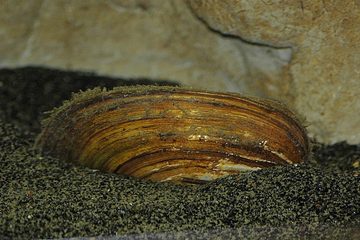
By 7 October 2026, nature conservationists and volunteers had returned more than 70,000 mussels to the water on the banks of the Slapy Reservoir, whose water level is falling because of hydrological drought. According to the Czech Union for Nature Conservation (ČSOP), more than 520 volunteers have taken part in the action.[1] On 3 October 2026 the union reported more than 60,000 mussels and over 400 volunteer participations.[2]
Reason for the action
According to ČSOP, the level of the Vltava on the Slapy Reservoir has been falling for about a month at a rate of 20 centimetres per 24 hours.[1] The Orlík Dam began reducing its outflow on 4 September 2026, and Povodí Vltavy is using water stored in Slapy for the first time in history to maintain the necessary flow of the Vltava in Prague. Before that, the level at Slapy stood at 269.3 metres above sea level; at the beginning of October 2026 it reached 264.1 metres.[2]
Endangered species
Hundreds of thousands of mussels of several species live in the reservoir, among them the legally protected painter's mussel and the rarer swollen river mussel. According to ČSOP, it is one of the most important habitats of these bivalves on the Vltava.[1] The fall in the water level has also exposed populations of millions of the invasive zebra mussel, which, according to ČSOP, competes with the native species for food, attaches itself to their shells and makes it harder for them to escape the falling water. Volunteers have to pull the zebra mussels off the collected native mussels.[1]
Organisation of the rescue
ČSOP coordinates the action with Povodí Vltavy. On the basis of an expert opinion from the Czech Academy of Sciences, it identified the 19 most critical areas, for which it set up a booking system on the website csop.cz.[1][2] At the current rate of decline, each area needs to be searched and the mussels returned to the water ideally once every two days, according to ČSOP. The organisation also calls for help on working days and has launched a fundraising appeal whose proceeds are to cover the coordination of the action and the securing of critical sections.[1][2]
Petr Stýblo of ČSOP said that the outcome of the rescue of the last large populations of endangered river mussels on the Vltava is not yet certain and depends on when the water level starts to rise again.[1]
Chronology
- — Conservationists and volunteers have returned more than 70,000 freshwater mussels to the water along the shores of the Slapy Reservoir, where the water level is falling because of hydrological drought. ČTK / České noviny Ekolist.cz
Sources
- ČTK / České noviny — 7 October 2026
- Ekolist.cz — 3 October 2026