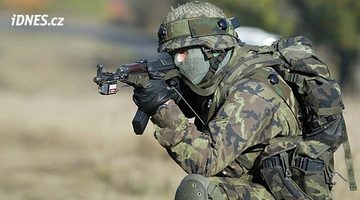
The government is set to discuss the Concept for Army Development to 2040. According to the draft, the Czech Republic fails to meet seventy percent of the capability-building targets set by NATO, and in the most demanding areas it lags five to ten years behind. The document states that this shortfall limits the ability of the Czech Armed Forces to fulfil collective defence tasks.[1][2]
The draft further describes low operational readiness and sustainability of forces, insufficient troop numbers, and a long-accumulated material deficit in equipment, supplies and infrastructure. It identifies major shortcomings in air and counter-drone defence, in territorial forces, and in host-nation support. The document also states that an attack on NATO and European Union member states, particularly by Russia, is becoming increasingly likely, and it draws attention to the shifting of responsibility for conventional collective defence from the United States to European allies.[1][2]
“As it is constructed, the concept is not realistic, because by 2040 — a fairly distant horizon — it still does not meet basic targets.”
The concept envisages a response in three phases, with milestones in 2030, 2035 and 2040. The so-called next-generation army is not to be completed until 2040, by which time air and counter-drone defence against ballistic and hypersonic missiles is also meant to be finished.[1][2]
According to iDNES.cz, the government of Andrej Babiš wants to keep defence spending at two percent of gross domestic product until 2029, reaching 2.25 percent only by the end of the first phase. Under the medium-term outlook of the state budget, Ministry of Defence spending is expected to total roughly CZK 190.9 billion in 2027, about CZK 211 billion in 2028, and about CZK 221.8 billion in 2029. A more significant increase is expected after 2030.[1][2]
Former Minister of Defence Jana Černochová (ODS) told iDNES.cz that, thanks to the modernisation already under way, the army is in better shape than a few years ago, but it is still paying the price for long-term underfunding. In her view, the concept confirms serious shortcomings in readiness for a large-scale conflict. She considers it alarming that there is a discrepancy between the document's conclusions and the current government's actions, and she is demanding that the government secure funding for troops, ammunition, air defence and continued modernisation.[1][2]
President Pavel's objections of 2 November 2026
Pavel attended the session mainly because of two agenda items, the long-term defence outlook and the concept, which he considers crucial given the current security situation. He declined to comment on the outcome of the discussion.[3][4][5]
According to the president, the goal of the concept should be a fully combat-capable army able to defend its own territory and fulfil its commitments to allies. Pavel said the Czech Republic is not meeting 70 percent of the required capability-building targets, and for those requiring the most resources it is lagging five to ten years behind.[6]
Pavel acknowledged that the government must also address other priorities, but pointed out that allies facing similar problems have nevertheless backed an increase in defence spending. He did not want to shift responsibility for the shortcomings onto the army, which depends on resources allocated by the political leadership. "It is the government that is responsible for the country's security," he said.[6]
According to a document obtained by the Czech News Agency, the planned financing through 2030 will allow only limited development of selected capabilities. The new draft raises the target number of professional soldiers to at least 32,000 by that year; the 2023 concept had envisaged at least 30,000. Key priorities include completing the heavy brigade, starting modernisation of the medium brigade, strengthening protection against airborne threats, and improving command and control.[3][6]
Government discussion of the concept on 2 November 2026
Under the draft, the army aims to reach at least 32,000 professional soldiers and 10,000 active reservists by 2030, and later to increase the number of reservists to 15,000. At the start of June 2026 it had more than 25,700 professional soldiers and more than 5,000 active reservists.[7][8][9]
Phases of capability development
According to the text of the concept, capability development proceeds in three phases. The first phase is set by the approved financial framework, which runs at 2 percent of GDP for the defence sector through 2029. Resources in this phase are concentrated on selectively eliminating urgent shortcomings, particularly in the heavy brigade and air defence. Comprehensive capability development is envisaged for the following two phases and is conditional on increased defence spending from 2030 onward.
According to the concept, the army's main task is the defence of the state through participation in NATO's joint defence effort.[8][9]
Government approval and the president's criticism
The government approved the concept on 2 November 2026 together with the Long-Term Defence Outlook to 2045. Prime Minister Andrej Babiš called both documents the most important items on the agenda and demanded that the army recruit at least three thousand new members each year, which he said had been achieved this year. He named air and counter-drone defence as the top priority. Minister of Defence Jaromír Zůna stressed the recruitment of qualified personnel.[10][11]
The concept points to a long-term shortage of equipment, supplies and infrastructure, to gaps in air defence, and to the fact that the Czech Republic meets only thirty percent of NATO's requirements.
President Petr Pavel, who attended the session, said afterward that the concept would ensure neither the fulfilment of allied commitments nor readiness for a higher-intensity conflict. He said: "As it is constructed, the concept is not realistic, because by 2040 — a fairly distant horizon — it still does not meet basic targets." In his view, the government does not treat defence spending as a priority. Babiš rejected the criticism, saying that while the army must be built up, it is also difficult to ensure adequate funding for healthcare and transport infrastructure. Zůna said this was not a race for percentages.[10][11]
According to the Czech News Agency, the government decided to update the concept two years earlier than originally planned, partly because NATO allies adopted new commitments last year. The new concept raises the planned number of professional soldiers for 2030 from 30,000 to at least 32,000.[11]
Chronology
- — The Government of the Czech Republic, with President Petr Pavel in attendance, discussed a new concept for the development of the Czech Armed Forces until 2040, which sets a target of at least 32,000 professional soldiers and 10,000 active reserve members by 2030. ČTK / České noviny iDNES.cz
- — President Petr Pavel criticised the proposed Concept for the Development of the Armed Forces until 2040, saying it would not allow Czechia to meet its NATO commitments, on the day the government discussed it at its meeting. ČTK / České noviny Deník.cz
- — The Government of the Czech Republic approved the Concept for the Development of the Armed Forces until 2040 and the Long-Term Outlook for Defence 2045; President Petr Pavel, who attended the meeting, said afterwards that in his view the concept would not ensure that allied commitments are met. Novinky.cz ČTK / České noviny
- — A draft concept for army development until 2040, due to be discussed by the government, states that the Czech army fails to meet 70 percent of NATO requirements and lacks the strength for a major conflict. iROZHLAS iDNES.cz
Sources
- iDNES.cz — 29 October 2026
- Lidovky.cz — 29 October 2026
- ČTK / České noviny — 2 November 2026
- Deník.cz — 2 November 2026
- FORUM 24 — 2 November 2026
- Ekonomický deník — 2 November 2026
- ČTK / České noviny — 2 November 2026
- iDNES.cz — 2 November 2026
- Lidovky.cz — 2 November 2026
- Novinky.cz — 2 November 2026
- ČTK / České noviny — 2 November 2026