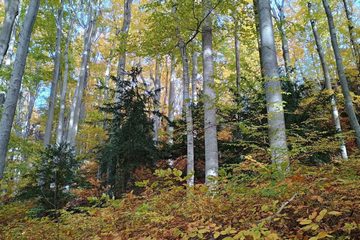
In November 2026, conservationists and foresters are searching the Jeseníky for local European yews whose seeds could be used to restore the species in the forests there.[1][2] Miroslav Havira of the Nature Conservation Agency of the Czech Republic said that, according to historical records, the yew was a natural part of the Jeseníky forests, but today only a few individual trees or populations survive. He considers it important to draw on local genetic material.[1][2]
Possible seed sources
Experts are assessing, among others, a female yew at the Skalní schody site near Vrbno pod Pradědem, whose age is estimated at about 400 years.[1][2] Other candidates are a protected yew in Mikulovice and yews near the ruins of Rychleby Castle.[1][2] First, however, more detailed information on the origin and genetic diversity of these trees is needed.[1] The Forestry and Game Management Research Institute (VÚLHM) has gathered historical documentation and carried out a genetic analysis of selected individuals.[2]
The population in the Na Špičáku nature monument
The largest yew population in the Jeseníky grows in the Na Špičáku national nature monument near Supíkovice.[1][2] An inventory in September 2026 recorded 1,240 individuals there, ranging in size from seedlings to a tree about twelve metres tall.[1][2] From there the yew is meant to spread to other parts of the mountain range.[1][2]
Protecting seedlings and further research
Restoration is complicated by roe deer browsing young trees. Seedlings are therefore protected by wire enclosures, which must remain in place for at least 20 years.[1][2] According to Novinky.cz, regeneration is concentrated in places that are hard for game to reach, and two female trees were freed from surrounding shade as an experiment, to observe their reaction to changed light conditions and seed production.[2]
Petr Novotný of VÚLHM said that the yew tolerates shade very well, but strong shade may not suit its long-term prosperity and reproduction. In his words, careful thinning of the stand can help natural regeneration, but it requires long-term monitoring to check that the intervention was not too strong.[1][2] A gradual review of known sites and further research are planned; Novotný described the return of the yew to the Jeseníky as a long-term undertaking.[1][2]
Chronology
- — Conservationists and foresters are searching the Jeseníky for local yews as a source of seeds to restore the species; they are also considering a tree about 400 years old near Vrbno pod Pradědem as a possible source. Hanácká Drbna Novinky.cz
Sources
- Hanácká Drbna — 8 November 2026
- Novinky.cz — 8 November 2026