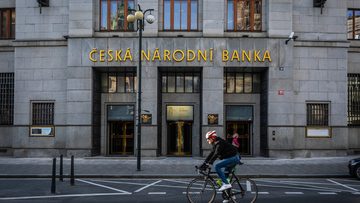
The seven-member Bank Board of the Czech National Bank (ČNB) decided on 5 November 2026 to raise the base two-week repo rate by 0.25 percentage points to four percent [3][4]. This is the highest level of the rate since the beginning of 2025. The board also raised the Lombard rate by the same amount to five percent and the discount rate to three percent [4].
Course of the rate in 2026
The ČNB first held the base rate at 3.5 percent this year. In June 2026 it raised it by a quarter of a percentage point to 3.75 percent and kept it at that level in August and September 2026 [4]. According to analysts approached by the Czech News Agency, the November increase was expected [1][2][3].
Reasons for the decision
Consumer prices rose year on year by 2.4 percent in October 2026, compared with 2.5 percent in September, according to a preliminary estimate by the Czech Statistical Office [3]. Martin Komrska, chief economist of UniCredit Bank, said the slowdown in inflation changes nothing about what he called "the persisting pro-inflationary undercurrent in the Czech economy" [1]. Core inflation, adjusted for the effect of energy, food, alcohol and tobacco, stayed at 3.3 percent, and prices of services grew at a rate of more than four percent [1][3].
Food prices were four percent lower year on year in October 2026, which dampened inflation. David Marek, chief economist of Deloitte, pointed out that while this year's food prices reflect last year's harvest, next year they will reflect this year's harvest, which he described as significantly worse [1][2]. Petr Dufek, chief economist of Banka Creditas, warned that the rise in wholesale energy prices, which in his view has been under way since February 2026, would pass into consumer prices at the turn of the year [1][2]. Václav Franče, an analyst at the Uniqa group, estimated that inflation would exceed 3.5 percent at the beginning of 2027 and might approach four percent [1][2]. Petr Zámečník, chief economist of FinGO, named as pro-inflationary risks the high state budget deficit and the end, from January 2027, of the shifting of payments for subsidised energy sources onto the state [1][2][3].
Statements by the Bank Board
Board member Jakub Seidler, according to the Reuters agency, leaned towards supporting a rate rise even before the vote, citing "resilient domestic demand" and long-term elevated energy prices [3]. ČNB Vice-Governor Jan Frait said, according to the Bloomberg agency, that the central bank "cannot and will not ignore" energy prices, but also warned against the ČNB "adding fuel to the fire" of rising market rates [3].
Reactions and next steps
Jiří Piluša, chief financial officer of the developer Neocity, said the market had expected the increase and that banks had "to a large extent already built it into mortgages in advance" [4]. The Bank Board is to meet once more in 2026 to set rates, a week before Christmas [4]. According to the chief economist of Banka Creditas, further developments will be decided mainly by inflation in January 2027, which will reflect new energy price lists and higher food prices [4].
Reactions to the Bank Board's decision
Prime Minister Andrej Babiš (ANO), in a Facebook video on 6 November 2026, called the Bank Board's decision of 5 November "absolutely scandalous". He said commercial banks would profit from it and mortgages would become more expensive for people. He pointed out that, according to Eurostat, inflation in the Czech Republic is 2.2 percent, whereas in the eurozone it is, in his words, four percent, with the European Central Bank's base rate at 2.5 percent.[5][6]
The decision to raise the rate by a quarter of a percentage point was not unanimous: four board members voted in favour and three wanted to keep the rate unchanged.[5][6]
Governor Aleš Michl told journalists that the increase was preventive, intended to rein in inflation expectations and limit the passing of the cost shock from rising energy prices into other prices. According to him, a new tightening cycle is not beginning and the ČNB is keeping all options open.
Former finance minister Miroslav Kalousek wrote on Facebook on 7 November that mortgage rates are determined by the estimate of inflation over roughly three years and by the state's borrowing needs, and that the government is more to blame for dearer mortgages than the ČNB. Strategist Bohumil Žitný of the company Žitný a partneři said the rate increase would gradually pass through to the entire financial market.[6]
Chronology
- — In a Friday video on Facebook, Prime Minister Andrej Babiš called the Czech National Bank board's Thursday decision to raise the base interest rate to four percent "absolutely scandalous". Echo24 Blesk.cz
- — The Czech National Bank raised its key interest rate by a quarter percentage point to four percent, the highest level since early 2025. Hospodářské noviny iDNES.cz
Sources
- Inflace meziročně zvolnila na 2,4 procenta. Je to jen dočasné, příští rok překročí tři procenta, tvrdí analytici
- Říjnové zvolnění inflace je dočasné, varují analytici. Příští rok přesáhne tři procenta
- Inflace dočasně zpomalila, brzy ale znovu zrychlí. ČNB nejspíš znovu zvedne úrokovou sazbu
- ČNB zvedla základní sazbu na čtyři procenta
- Echo24
- Blesk.cz