The Czech Republic joined the North Atlantic Treaty Organization (NATO) on 12 March 1999, together with Poland and Hungary.
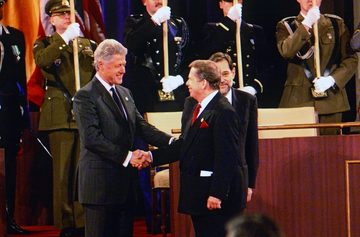
The accession of the Czech Republic to NATO is an event of 12 March 1999, when the Czech Republic, together with Poland and Hungary, joined the North Atlantic Treaty Organization. According to the Ministry of Defence of the Czech Republic, the accession completed many years of diplomatic effort to integrate the country into transatlantic ties and meant a return to the community of liberal democracies that guarantee the protection of human and civil rights, freedom of expression, the rule of law and a free market [2].
The road to accession
After the Velvet Revolution, Czechoslovakia began to seek new security guarantees. The political leadership of the time worked systematically for the withdrawal of Soviet troops and for the end of the Warsaw Pact. On the second matter it found no support in Washington, from where voices warned against a hasty dissolution of a pact that had been dominated by Moscow since its founding. Czechoslovakia eventually carried through its course [1].
The end of the Cold War forced the United States to consider the future direction of the Alliance. Among the key steps was the creation of the North Atlantic Cooperation Council (NACC), whose inaugural meeting at the level of foreign ministers took place in December 1991 with the participation of NATO member states and nine other European countries, Czechoslovakia among them. In the context of the time it was unclear whether this step was merely a tactical manoeuvre to slow the integration ambitions of the former Soviet satellites [1].
According to the former American diplomat Ronald Asmus, a heated debate on national security, linked to the question of the Alliance's enlargement, gradually developed in the United States. American ideas about the future shape of Europe at first did not include NATO enlargement into Central Europe, Western European states took a lukewarm stance, and Moscow opposed it [1].
The role of Bill Clinton and the American administration
The turning point was the election of Bill Clinton as American president. When he took office in 1993, he was regarded as a politician with little interest in foreign policy, but as president, according to the Military History Institute Prague (Vojenský historický ústav Praha), he proved the opposite and pushed through in his own administration the view that enlargement of the Alliance benefits the existing members as well [1]. Another milestone was the NATO summit held on 10 and 11 January 1994 in Brussels, at which the Partnership for Peace programme was introduced [1].
Critics of enlargement claimed that it was a mistaken step that would slow democratic reforms in Russia or provoke a new Cold War. Clinton carried enlargement through without damaging relations with Russia, among other things thanks to his personal relationship with the Russian president Boris Yeltsin. The claim that enlargement would endanger the functioning and cohesion of NATO did not come true either [1].
According to Vojenský historický ústav Praha, it was important for gaining American support that the Czech Republic, Poland and Hungary strongly wanted to join NATO and saw it as the culmination of their struggle for freedom and democracy. In this spirit, the Czech president Václav Havel, the Polish president Lech Wałęsa and the Hungarian president Árpád Göncz made an impression on Clinton as early as the spring of 1993 [1]. In 1993 the journal Foreign Affairs published an article on the need to build new relations between the USA and Europe, co-authored by Ronald Asmus, who as a member of the Clinton administration played a role in the enlargement of the Alliance [1].
Consequences for the Czech army
According to the Ministry of Defence of the Czech Republic, accession to NATO made a fundamental reform of the armed forces possible. The professionalisation of the army began in 2004 and was completed as of 1 January 2005. The Czech army then began to take an intensive part in NATO operations abroad, for example in the Balkans, Afghanistan, Iraq and the Baltic states [2].
Public perception
According to a survey by the STEM/MARK agency commissioned by the Ministry of Defence of the Czech Republic, conducted from 24 February to 1 March 2022, 69 percent of respondents regarded NATO membership as a guarantee of the security of the Czech Republic and its citizens, and 80 percent believed that membership helps prevent threats, above all war (53 percent), threats to the sovereignty of the Czech Republic (32 percent), terrorism (23 percent) or the influence of authoritarian regimes (22 percent) [2]. Helping another member state in the event of an attack was approved by 73 percent of those asked, and 79 percent of respondents were in favour of enlarging the Alliance [2]. The then Minister of Defence Jana Černochová said on the anniversary of accession that "the last days and weeks show how vitally important NATO membership is" [2].
Sources
- Vojenský historický ústav Praha — 29 March 2019
- Ministerstvo obrany České republiky — 12 March 2022