The Velvet Revolution was a series of anti-communist demonstrations and political changes in Czechoslovakia that began on 17 November 1989 with the intervention of the security forces against a student demonstration on Národní in Prague and led to the end of forty years of Communist Party rule.
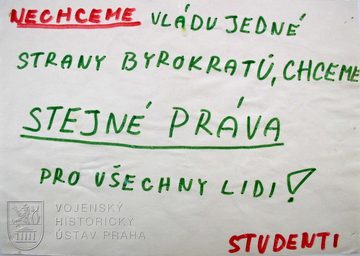
The Velvet Revolution is the name for the events that were set off in Czechoslovakia by the intervention of the security forces against a student demonstration on 17 November 1989 on Národní in Prague. According to Vojenský historický ústav Praha, this intervention triggered the end of the forty-year rule of the Communist Party in what was then Czechoslovakia, while the demonstration itself was only a further consequence of the already smouldering dissatisfaction of the population with the state of the country at the end of the 1980s [1].
The link to 1939
The date of 17 November was chosen to commemorate events of 1939. At that time the Nazi Protector Konstantin von Neurath issued a decree closing the Czech universities for three years. The pretext was a series of autumn student demonstrations against the occupation, the last of them at the funeral of the medical student Jan Opletal [1]. Opletal was shot during a demonstration held on 28 October 1939 on the anniversary of the founding of independent Czechoslovakia and died of his injuries on 11 November 1939. At the same demonstration the worker Václav Sedláček was shot dead by the Nazis [1]. Opletal's funeral took place on 15 November 1939 at Albertov in Prague and provoked further mass protests. Shortly before midnight on 16 November the Nazis occupied the university dormitories, arrested students and teachers, and shot nine representatives of student associations at the barracks in Ruzyně. Subsequently 1,200 students were transported to the Sachsenhausen concentration camp, more than 15,000 students lost the opportunity to study, and more than 1,300 teachers found themselves without work. Two years later, on 17 November 1941, International Students' Day was proclaimed in London [1].
The course of events in 1989
The demonstration of 17 November 1989 began in the afternoon at Albertov in Prague, and its purpose was to commemorate precisely the events of 1939. Towards evening the march reached Národní, where the security forces suppressed the assembly by force [1]. According to Vojenský historický ústav Praha, the brutal intervention, accompanied by reports of a supposedly dead student, activated Czech society, and a considerable part of the population that had until then stayed out of the protests also began to express disagreement with the conduct of the security forces [1]. Artists and actors from Prague theatres and others quickly joined the protesting students and went on strike over the weekend and on Monday respectively [1]. On Sunday evening, 19 November 1989, the political platform Civic Forum was formed [1].
The centre of subsequent events became Wenceslas Square in Prague, where hundreds of thousands of people gradually came to repeated assemblies. On the balcony of the Melantrich publishing house building in the middle part of the square appeared both representatives of the dissent and artists who had until then been proscribed by the Communist regime [1].
Outcome
Vojenský historický ústav Praha summarises the events as the culmination of a half-century period during which the Czech nation faced oppression both from outside and from a party of its own that had usurped power, and the era of totalitarian regimes thereby came to an end [1].
Commemoration
17 November is a public holiday in the Czech Republic, the Struggle for Freedom and Democracy Day, which commemorates both historical events, the protests of 1939 and the events of 1989 [1].
Sources
- Vojenský historický ústav Praha — 17 November 2021