The Prague Spring was a period of political liberalisation in Czechoslovakia in 1968 under the leadership of Alexander Dubček, which ended with the invasion of Warsaw Pact troops on 21 August 1968.
The Prague Spring denotes a short period of Czechoslovak history in which the communist regime attempted a loosening of control and offered people a limited degree of freedom. It began with the rise of Alexander Dubček and ended in August 1968, when Warsaw Pact troops invaded the country.[1][2] According to Czech Television, the slogan of the period was “socialism with a human face”.[2]
The start of the reforms
According to the Military History Institute Prague, the main protagonists did not at first expect changes on so large a scale. Under the label of democratisation, a replacement of cadres within the party was to take place. The group around Antonín Novotný was succeeded by a generation of relatively progressive communists headed by Alexander Dubček. The institute stresses that these were people who, after February 1948, had served the party in lower posts.[1] In the spring of 1968 a process of democratisation nevertheless began, and it took an ever more real shape.[1]
The new leadership wanted to address chiefly the economy, which had for years been burdened by armament and a one-sidedly oriented industry. A rise in living standards was also to be achieved, and in the more relaxed atmosphere of the second half of the 1960s people were able to compare life in the West and in the East.[1]
Political changes
At the same time, voices grew louder demanding redress for the political persecutions of the first half of the 1950s. Judicial rehabilitations took place which no longer concerned only people connected with the Slánský trial but the actual victims of the regime. Supervision of freedom of speech ended and censorship was abolished.[1] New political groupings emerged, for example KAN and Club 231, which brought together former political prisoners. The renewal of social democracy was discussed, as was the creation of a youth organisation that would replace the existing ČSM (Czechoslovak Union of Youth) and be less dependent on the Communist Party. These associations stood outside the National Front, for the first time since 1945.[1]
The army
The changes also affected the army. The people around Minister of National Defence Bohumír Lomský left the command, and their posts were taken by the later “normalisers” led by General Martin Dzúr. In the army, thought was given to the position of Czechoslovakia within the Warsaw Pact, attention was drawn to the unequal standing of the allies, and some extreme views even mentioned neutrality.[1] The command nevertheless continued to search for a model of the army that would reconcile its needs with the demands of society.[1]
The Šumava exercise and the end
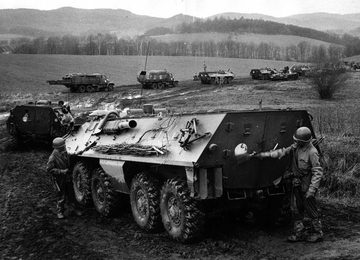
In the middle of the summer of 1968 the last soldiers of the Warsaw Pact exercise Šumava left Czechoslovakia. Shortly afterwards, on 21 August 1968, they returned as occupiers. During the exercise the Soviets had already made clear to Czechoslovak soldiers their dissatisfaction with developments in the country.[1] A programme by Czech Television from the series Dějiny udatného českého národa (History of the Valiant Czech Nation) names Ludvík Svoboda and Leonid Brezhnev among the key figures.[2]