The Slánský trial was a staged political trial held in November 1952, in which the general secretary of the Communist Party of Czechoslovakia (KSČ), Rudolf Slánský, and other senior officials were convicted; eleven of the convicted were executed.
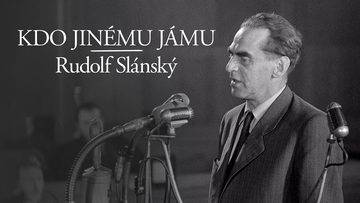
The Slánský trial was a staged political trial in Czechoslovakia held in November 1952. The defendants were Rudolf Slánský, the former general secretary of the Central Committee of the Communist Party of Czechoslovakia (KSČ), and other senior officials of the party. [1][2]
Causes and preparation
Under Rudolf Slánský's leadership, dozens of political trials modelled on the Soviet example took place in the 1950s, among them the trial of Milada Horáková. According to Czech Radio, historians link Slánský's fall to precisely that trial, which was supervised by Soviet advisers. In their view it was not flawless, so they looked for defendants of still higher rank. This possibility is raised by the historian Jiří Kocián of the Institute of Contemporary History. [1] Slánský was arrested on 23 November 1951. [3]
Course of the trial and sentences
According to a Czech Television documentary, the trial ended in November 1952 with eleven former senior KSČ officials executed. In court they answered questions from prosecutors and judges that they already knew in advance, and they recited confessions they had learned, along with accusations against their former colleagues. [3] Rudolf Slánský received the death sentence in November 1952. [1] The Security Commission of the KSČ Central Committee had nine members, and it was the body that approved the script of the Milada Horáková trial. After that trial, four more of its members ended on the gallows alongside Slánský. [1]
Fates of the convicted
The youngest of the eleven executed men was Rudolf Margolius, a deputy minister of foreign trade, born in Prague in 1913. During the war he was deported with his wife in 1941, because of his Jewish origin, to the Łódź ghetto and later to Auschwitz, and he also survived Dachau, from which he escaped in April 1945. He joined the KSČ at the end of 1945. In 1948 he became head of the cabinet of the minister of foreign trade and in 1949 a deputy minister; he directed trade with capitalist countries and negotiated several economic agreements with Great Britain. [2]
In January 1952 Margolius was arrested and placed in the group around Slánský. In November 1952 he was accused at the trial of having negotiated economic agreements with the West, although the Soviet Union wanted the economy to be oriented toward the countries of the socialist bloc. According to Czech Radio, historians still regard his inclusion in the trial as unclear, because he was neither a high-ranking communist nor connected to the security apparatus. He was hanged on 3 December 1952 in Prague, and before his death he wrote two letters, to his wife and to his son. [2] The radio also mentions Ludvík Frejka, who confessed to everything in court and was likewise hanged. [2]
Context
The Czech Television documentary Kdo jinému jámu from 2020 (directed by Martin Vadas) explains that the Soviet advisers, whom Slánský and Klement Gottwald had invited to the country, determined the course of the staged trials, and that Slánský became their victim. [3]