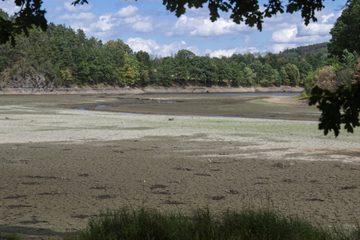
On 6 October 2026 the South Bohemian Region declared a drought emergency for its entire territory; the Husinecká přehrada reservoir in the Prachatice area is almost empty.
The South Bohemian Region declared a drought emergency for its entire territory on 6 October 2026. The region has been suffering from drought for several weeks, and because of a long-term lack of rainfall millions of cubic metres of water are missing in reservoirs, ponds and rivers.[2] Among other things, the declaration allows faster handling of outflow from reservoirs: under normal conditions various institutions, for example the fishing association, would have to give their opinion on it and the procedure would take several days, whereas during a drought emergency Povodí can proceed immediately in cooperation with the region.[1][2]
Husinecká přehrada
According to Jiří Baloun, the director of the Horní Vltava plant of Povodí Vltavy, the Husinec reservoir on the Blanice river became the first Czech dam to have almost dried up. The storage space held 30,000 cubic metres of water, that is 1.3 per cent of the normal volume, and the water level had dropped seven metres below normal.[1] Povodí Vltavy will therefore begin releasing only the inflow and will stop improving the flow of the Blanice with water. This will happen once the minimum operating level of 515.33 metres above sea level is reached, which Baloun estimated at about two days. According to him, this has not happened during his time in the job.[1]
The Husinec waterworks was built between 1934 and 1939 about three kilometres above the town of Husinec. It originally served for flood protection and for retaining water in periods of drought. Since 1962 it has been a drinking-water reservoir for the town of Prachatice. The masonry dam is 197 metres long and the reservoir floods 61 hectares.[1]
Římov reservoir
Povodí of the Vltava is preventively reducing the outflow from the Římov Reservoir in the České Budějovice area from about 500 to 400 litres per second; the inflow is approximately 200 litres per second. The reservoir holds over 16 million cubic metres of water, that is 55 per cent of its capacity, and supplies drinking water to more than 360,000 inhabitants of the region.[2] The regional governor Martin Kuba (Naše Česko) said after a meeting of the crisis staff that the smaller volume of water makes its treatment more difficult because more cyanobacteria multiply in the reservoir. The South Bohemian Water Supply Association therefore put back into operation the water treatment plant on the Otava in Písek, which had suspended operation this year because of the low level of the river. The governor also asked residents not to waste water.[2]
Related entries: Husinecká přehrada, South Bohemian Region, Povodí Vltavy
Impact of the drought on autumn pond harvests
According to the Czech News Agency, the drought is affecting the autumn pond harvests in the South Bohemian Region. More than half of the water has evaporated from the ponds, water is also lacking at the holding tanks and inflows are drying up. Fishermen are therefore transferring and pumping water between ponds and holding tanks. The harvests of large ponds are being postponed to the turn of November and December so that the Christmas carp spend as little time as possible in the holding tanks.[3][4]
Vladimír Kaiser, managing director of Rybářství Hluboká, said that the Hluboká fishermen had cancelled the ceremonial harvests and are adjusting the schedule as they go. The harvest of the Munický pond, which covers more than a hundred hectares, was postponed to 3 and 4 December 2026, because it lies above the holding tanks and the fishermen are trying to hold the water in it for as long as possible.[3][4]
Vladimír Kukačka, production director of Rybářství Třeboň, said that they stopped taking measurements about two weeks before the report was published. At that time 45 per cent of the water was missing out of a total volume of 75 million cubic metres. The harvest of the Rožmberk, the largest Czech pond, is not taking place in 2026. It will be replaced by Days with Třeboň Fishermen at the holding tanks on Friday and Saturday, 16 and 17 October 2026. The harvests of the Záblatský pond and Velký Tisý are being prepared for the end of November. The fishermen are not counting on harvesting the Horusický, Dvořiště and Bošilecký ponds in 2026.[3][4]
In the area around Nové Hrady a third of the water remained in some ponds and the fishermen are using pumps. Lubomír Zvonař, director of Rybářství Nové Hrady, said that in 46 years on the site he had never experienced the inflows and streams drying up and water lacking for the holding tanks, not even in the dry years 1984 and 1985. The harvest of the Byňovský pond was planned for 21 October 2026.[3][4]
Husinec reaches minimum operating level on 8 October 2026
On 8 October 2026 the Husinec reservoir reached the minimum operating level of 515.33 metres above sea level, that is seven metres below the normal level, and began releasing only as much water as flows into it. According to Jiří Baloun, director of the Horní Vltava plant of Povodí Vltavy, the storage space, whose volume exceeded two million cubic metres, had been used up. The part intended for permanent retention of water remained full. Previously the reservoir released roughly 400 litres per second; now about half that amount flows into the Blanice. According to the Czech News Agency, it was the first dam in the Vltava basin whose storage space had been exhausted.[5]
The Husinecká přehrada has a masonry dam 197 metres long and a flooded area of 61 hectares. The height of the dam crest above the valley is 27.20 metres, a road from Husinec to Prachatice runs along the dam and the backwater of the reservoir is 3.5 kilometres long.[5]
The Římov reservoir, which supplies drinking water to a large part of the region, was 54 per cent full according to the Czech News Agency, and Povodí Vltavy reduced its outflow for preventive reasons. The Hněvkovice and Kořensko reservoirs, which are important for cooling the Temelín Nuclear Power Station, were 88 and 98 per cent full.[5] Petr Kubala, director general of Povodí Vltavy, said that all the reservoirs supplying drinking water are sufficiently full and no restrictions on supplies are threatened. Povodí Ohře has been reducing the outflow from the Březová Reservoir from 170 to 150 litres per second since 8 October 2026.[6]
- Husinec jako první česká přehrada téměř vyschl, začne vypouštět pouze přítok
- Povodí sníží kvůli suchu odtok z Římova, kraj nabádá občany neplýtvat vodou
Chronology
- — Drought in the South Bohemian Region is delaying the autumn pond harvests: fishery operators are postponing the harvests of large ponds to the turn of November and December, Rybářství Hluboká has cancelled its ceremonial harvests, and the harvest of Rožmberk, the largest Czech pond, is not taking place this year. Ekolist.cz Deník: České Budějovice / Jižní Čechy
- — According to ČTK, the Husinec Reservoir on the Blanice river in the South Bohemian Region became the first in Czechia to run empty and, because of drought, began releasing only its inflow. ČTK / České noviny iROZHLAS
- — South Bohemian Region declared a state of drought for its entire territory, and the Husinec reservoir in Prachatice District has almost run dry because of the prolonged drought. ČTK / České noviny ČTK / České noviny