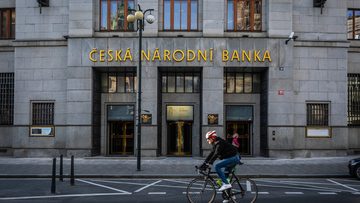
The seven-member Bank Board of the Czech National Bank (ČNB) decided on November 5, 2026, to raise the key two-week repo rate by 0.25 percentage points to four percent [3][4]. This is the highest level of the rate since the beginning of 2025. At the same time, the board raised the Lombard rate by the same amount to five percent and the discount rate to three percent [4].
Rate Developments in 2026
The ČNB's key rate was initially held at 3.5 percent this year. In June 2026, it was raised by a quarter of a percentage point to 3.75 percent, and it remained at this level in August and September 2026 as well [4]. According to analysts contacted by the Czech News Agency, the November increase was expected [1][2][3].
Reasons for the Decision
Consumer prices rose by 2.4 percent year on year in October 2026, compared with 2.5 percent in September, according to a preliminary estimate by the Czech Statistical Office [3]. UniCredit Bank's chief economist Martin Komrska said the slowdown in inflation changed nothing about what he described as a "persistent inflationary undercurrent in the Czech economy" [1]. Core inflation, which strips out the effects of energy, food, alcohol and tobacco, remained at 3.3 percent, and service prices grew at a rate of more than four percent [1][3].
Food prices in October 2026 were four percent lower year on year, which dampened inflation. Deloitte's chief economist David Marek noted that while this year's food prices reflect last year's harvest, next year will reflect this year's harvest, which he described as significantly worse [1][2]. Banka Creditas chief economist Petr Dufek warned of the pass-through of rising wholesale energy prices, which he said has been underway since February 2026, into consumer prices around the turn of the year [1][2]. Uniqa group analyst Václav Franče estimated that inflation will exceed 3.5 percent at the start of 2027 and could approach four percent [1][2]. FinGO chief economist Petr Zámečník identified the high state budget deficit and the end of the state's taking over payments for supported energy sources from January 2027 as inflationary risks [1][2][3].
Statements by the Bank Board
According to Reuters, Bank Board member Jakub Seidler had already indicated support for a rate hike before the vote, citing "resilient domestic demand" and persistently elevated energy prices [3]. ČNB Deputy Governor Jan Frait told Bloomberg that the central bank "cannot and will not ignore" energy prices, while also warning against the ČNB "pouring oil on the fire" of rising market rates [3].
Reactions and Next Steps
Jiří Piluša, financial director of developer Neocity, said the market had expected the rate increase and that banks had "largely already factored it into mortgages in advance" [4]. The Bank Board is set to discuss rate settings once more in 2026, a week before Christmas [4]. According to Banka Creditas's chief economist, further developments will depend mainly on January 2027 inflation data, which will reflect new energy price lists and higher food prices [4].
Chronology
- — In a Friday video on Facebook, Prime Minister Andrej Babiš called the Czech National Bank board's Thursday decision to raise the base interest rate to four percent "absolutely scandalous". Echo24 Blesk.cz
- — The Czech National Bank raised its key interest rate by a quarter percentage point to four percent, the highest level since early 2025. Hospodářské noviny iDNES.cz
Sources
- Hospodářské noviny — 4 November 2026
- iDNES.cz — 4 November 2026
- Echo24 — 5 November 2026
- Novinky.cz — 5 November 2026