Charter 77 was a civic initiative in communist Czechoslovakia whose declaration was published on 6 January 1977 and signed by 241 citizens.
Charter 77 was the name of a civic initiative in communist Czechoslovakia and at the same time of its declaration, which was published on 6 January 1977. It was signed by 241 Czechoslovak citizens, and outwardly they were represented by three spokespersons: the philosopher Jan Patočka, the politician Jiří Hájek and the playwright Václav Havel.[1]
Content of the declaration
The declaration referred to international documents adopted by the Czechoslovak state and recalled that responsibility for the observance of human and civil rights lies above all with political and state power. It also pointed out that everyone bears a share of responsibility for general conditions.[1] The Military History Institute Prague states that it was based on the Helsinki Accords, in which Czechoslovakia had committed itself to respect human rights and fundamental freedoms. It describes the declaration as the best-known document of the period criticising conditions in communist Czechoslovakia.[2] According to the institute, the initiative did not define itself politically against communism or socialism and stressed that it was not a base for oppositional political activity.[2]
Reaction of the regime
According to the Government of the Czech Republic, repression of the signatories began on the same day. Dozens of house searches took place and a number of signatories were detained. An extensive campaign against the Charter began in the media, although the text of the declaration was not officially published anywhere.[1] According to the Military History Institute Prague, on 6 January the spokesperson Václav Havel and the signatories Pavel Landovský and Ludvík Vaculík were arrested by the State Security while distributing the text.[2]
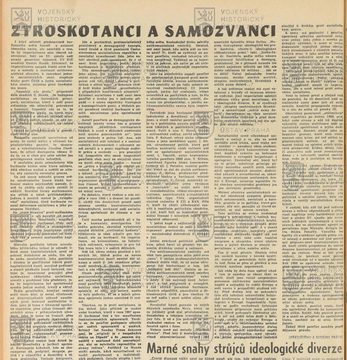
The first public statement by the authorities in the press was the article “Ztroskotanci a samozvanci” (“Failures and Self-Styled Figures”), published on 12 January in Rudé právo. It was taken over by other newspapers, including the army daily Obrana lidu, where it appeared a day later.[2] The Military History Institute Prague notes that the article quotes not even the text of the declaration. In its view the attack was aimed not at the document but at the signatories and the circle of people around it. Obrana lidu also printed resolutions from military meetings and responses from soldiers who condemned the declaration without having read it.[2]
Further developments
The spokesperson Jan Patočka died on 13 March 1977. The government links his death with the persecution connected with his involvement. In an atmosphere of repression and public denigration, several hundred more citizens added their signatures.[1]
Commemoration
On the 40th anniversary of the publication of the declaration, the Government of the Czech Republic issued a statement on 9 January 2017 in which it affirms the tradition of the Charter 77 struggle for human and civil rights and describes it as an important movement of modern Czech history. In it, it pays tribute to the victims of repression connected with the Charter and with other independent initiatives of the time.[1]