On 25 October 2026 the Speaker of the Chamber of Deputies, Tomio Okamura, said that funding for Czech Television and Czech Radio from the budget would come from reserves and would not raise the deficit.
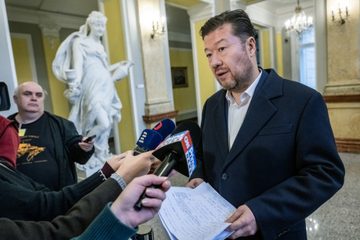
The Speaker of the Chamber of Deputies of the Parliament of the Czech Republic, Tomio Okamura (SPD), said on 25 October 2026 on the programme Partie of CNN Prima News that funding Czech Television and Czech Radio from the state budget would not raise the budget deficit. According to him, the government of ANO, SPD and the Motoristé wants to take roughly CZK 7.8 billion from the budget reserves. Okamura said that, according to his information, there is some room in the reserves and that the coalition is internally prepared for the change. According to him, the coalition council has already dealt with the question.[1]
The draft amendment
In the early hours of Saturday 24 October 2026, after a night session, the lower house, with the votes of government MPs, sent to second reading an amendment that envisages abolishing licence fees for both institutions. Under the amendment, Czech Television is to receive CZK 5.74 billion from the budget next year, about a billion less than it plans to collect in fees this year. Czech Radio is to receive CZK 2.065 billion, roughly 400 million less.[1]
Criticism
STAN MP Věra Kovářová pointed out that the budget reserves contain around eight billion crowns, which would be enough to fund both media. She described the use of the reserve as problematic, because no money would then be left for a crisis or disaster. The opposition criticises the plan to abolish the fees on the grounds that it will burden the state budget. Former prime minister Petr Fiala (ODS) reproached the government in the same television debate that the deficit exceeds spending on investment by roughly CZK 100 billion.[1]
The lower house approved the basic parameters of the draft budget for next year on Thursday 22 October 2026 with the votes of the coalition. The deficit is to rise from CZK 310 billion to 386 billion, revenue to CZK 2.199 trillion and expenditure to CZK 2.585 trillion.[1]
Media committee debate on funding Czech Television and Czech Radio
The media committee of the lower house discussed the government's proposal to abolish fees for Czech Television and Czech Radio and to move their funding to the state budget. Minister of Culture Oto Klempíř (for the Motoristé) accused the opposition in the debate of dragging public service media into a political fight and making them hostages in a dispute. He rejected the opposition's concerns about a loss of independence. Staff of Czech Television and Czech Radio have announced a full-day strike for Tuesday 3 November 2026.[2][3]
Klempíř said that only the method of funding is changing, that the media will save money because they will not have to collect the fees, and that the predictability of their budgets will increase. Under the proposal, Czech Television is to receive a billion crowns less next year and Czech Radio 400 million less. He rejected that it was an experiment or a specifically Czech solution, pointing to the European Media Freedom Act (EMFA) and to other European countries. Denmark has moved to funding from the state budget with multi-year agreements since 2022, and in Sweden and Finland special taxes have replaced the fees.[2][3]
Former Minister of Culture Martin Baxa (ODS) asked whether Klempíř believes that Andrej Babiš as prime minister will not try to influence the broadcasting of Czech Television and Czech Radio. Klempíř replied that the proposal strengthens the predictability of funding. Baxa described the way the coalition pushed through the first reading as a "night blitzkrieg". ANO MP Ondřej Babka repeated that the amount of the fee is already set by Parliament.[2][3]
The committee chairman František Talíř (KDU-ČSL) said that funding from the budget will raise the state deficit and that everyone will pay for the media through taxes, plus 400 million crowns in interest on the higher debt. According to him, KDU-ČSL rejects the proposal because it sees room in it for political pressure on the media, and he called the way the first reading was handled unprecedented. The coalition moved the first reading ahead in the agenda of the Friday session of the lower house, and the proposal passed in the early hours of Saturday.[2][3]
Chronology
- — The leader of the SPD movement, Tomio Okamura, insists on abolishing licence fees for Czech Television and Czech Radio and rejects replacing them with any form of tax. ČTK / České noviny iDNES.cz
- — The Chamber of Deputies' media committee debated a government bill abolishing licence fees for Czech Television and Czech Radio and shifting their funding to the state budget, Culture Minister Oto Klempíř accused the opposition of dragging public-service media into a political fight, and employees of both broadcasters announced an all-day strike for 3 November. ČTK / České noviny Blesk.cz
- — Tomio Okamura, Speaker of the Chamber of Deputies, said that the money for public service media will come from budget reserves and will not raise the state budget deficit. iROZHLAS ČTK / České noviny
Sources
- ČTK / České noviny — 25 October 2026
- ČTK / České noviny — 29 October 2026
- Ekonomický deník — 29 October 2026
- ČTK / České noviny — 30 October 2026
- iDNES.cz — 30 October 2026