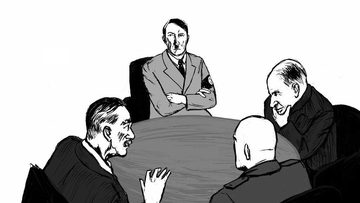
The Munich Agreement is an international agreement signed in Munich at the turn of 29 and 30 September 1938. Germany, Italy, Great Britain and France agreed in it that the Czechoslovak borderland would pass to Nazi Germany. Czechoslovakia was not present at the negotiations.[1]
Prelude: disputes within Czechoslovakia
A documentary film from 2022, an excerpt of which was published by Czech Television, follows the development of the Sudeten German movement and of Czech-German relations from the 1930s until the time of the Protectorate. It stresses the role of Henlein's Sudeten German Party, which, according to the excerpt, contributed significantly as an anti-system force to the breakdown of the democratic system of the First Republic.[2]
Consequences for the state
Czechoslovakia lost extensive territories with their population, as well as its border fortifications, which weakened the state considerably. A few months later, in March 1939, Nazi Germany occupied the Czech lands.[1]
Ladislav Kudrna, the director of the Institute for the Study of Totalitarian Regimes, said of the significance of the event that it cannot be reduced to the signature itself or to the loss of the border territories. In his words, the powers decided on the territory and security of Czechoslovakia without its participation and under strong pressure, and the effects were political, military and social. Along with the borderland itself, the country, he said, also lost its fortifications and a large part of its economic potential, and Munich fundamentally changed the conditions in which the state tried to withstand the growing pressure of Nazi Germany.[1]
Reaction of society
Czech society received the agreement as a shock. According to the excerpt from the documentary, it led to an intense Czech nationalism, and in public space demands accumulated that the Czech language and culture be freed of foreign elements.[2]
Commemoration
The Institute for the Study of Totalitarian Regimes has long dealt with Nazi Germany, prewar Czechoslovakia and the wider context of European dictatorships. In 2023 it organised the lecture Munich 1938 at the 3Kino cinema in Prague. The speakers were the historian Eduard Stehlík, the director Ladislav Kudrna and Kamil Nedvědický, the first deputy director. The debate touched, among other things, on how the Nazi and the communist dictatorships worked and how they affected European history of the 20th century.[1] On the 88th anniversary of the agreement, the institute also recalled in a news item the director's statement that Munich, February 1948 and August 1968 were "plagues" that broke the backbone of the nation.[1]