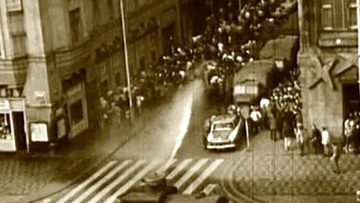
Normalization is the term for the political and social conditions in Czechoslovakia after 1968. Under the leadership of Gustáv Husák, every effort to loosen the socialist system was suppressed. At the same time the regime sought to make people feel that the country was a good place to live.[1][2]
Protests in August 1969
Czech Television recalls that normalization damped down anything that might have eased the regime, and people fell into depression. Nevertheless, around 21 August 1969 they went out into the streets to show the country's leadership their disagreement with the direction the republic was taking. A wave of protests swept the country. The Communists were prepared for it and acted harshly: five people lost their lives in street clashes and a number of others were injured.[1]
The inhabitants kept recalling the August occupation in later years as well, which is why 21 August was among the anniversaries most feared by the authorities of the time.[1]
The year 1975
Czech Radio counts the change in the presidency among the symbols of normalization. In May 1975 Gustáv Husák replaced the ailing Ludvík Svoboda.[2] According to the radio, a number of other projects were carried out or completed in the same year: a modern hospital in Most in northern Bohemia, a new chemical plant in Kralupy nad Vltavou, the whole Vřídelní kolonáda complex in Karlovy Vary, the largest bakery in Prague in Michle, and Labská bouda. The fourth Spartakiad took place and in Most the deanery church was moved. A motorway was being built in the country, and in Prague one metro line was running while another was under construction. The Intercontinental hotel had already opened in 1974.[2]
Living standards and consumption
According to the radio, most people accepted this state of affairs. In the first half of the 1970s the birth rate rose sharply, and 1974 brought the highest number of births in Czechoslovakia since the end of the Second World War. The period was characterised by flats allocated by enterprises, widely available Škoda cars and favourable loans for newlyweds.[2]
In spring 1975 two shopping venues were added in Prague. The Kotva department store opened on Monday 10 February, and the opening of the Máj department store fell on Monday 21 April. Commentaries in Rudé právo linked them with the care that party and state bodies took of socialist trade.[2] With the opening of Kotva, more than 250 small shops disappeared from the streets of Prague. Kotva soon became a place that neither village excursions to the Prague sights nor foreign guests could skip. The radio tells of a group of Soviet tourists who assessed their stay in Prague, including the visit to the new department store, on their last evening in a hotel restaurant, without their leader noticing the presence of a Czech guide.[2]
Assessment by a historian
The historian Martin Franc describes the mid-1970s as a period when living standards rose, supplies improved and money was invested in infrastructure. In his view the regime clearly tried to redirect people's attention from politics to other topics.[2] The radio gives the opening of the luxury Intercontinental hotel in 1974 as evidence that foreign visitors were also meant to gain an impression of these changes.[2]