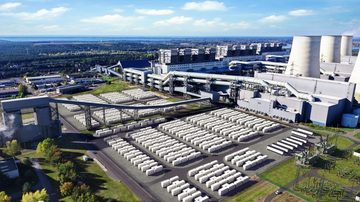
On 3 November 2026 the German government, through the Federal Network Agency (Bundesnetzagentur), awarded eleven contracts for building new gas-fired power plants or converting existing coal-fired plants to gas. The contracts had a total value of about 12 billion euros, or more than 290 billion Czech koruna. Seven of them were won by LEAG, which belongs to the EP Group of businessman Daniel Křetínský [2][3].
Scale and location of the projects
The total generating capacity of the eleven awarded contracts is 5.16 gigawatts, of which roughly three gigawatts fall to LEAG according to the agencies Reuters and DPA [2]. According to LEAG, these are seven gas units with a total output of 3,680 megawatts [1]. Four units of 560 megawatts each are to be built in Jänschwalde in Brandenburg and two identical units in Boxberg in Saxony. The seventh unit is to be a 320-megawatt plant in Leipheim in Bavaria, where LEAG has operated a gas turbine for grid stabilisation since 2023 [1]. The new units are to be ready by the end of 2031 at the latest [1] and are to be adapted for burning hydrogen as well [1]. The company estimates its investment at 1.5 to 2 billion euros, or 36.4 to 44.8 billion koruna [1].
Most of the new plants are to be built on the sites of existing coal-fired plants in eastern Germany, which according to LEAG should reduce both costs and construction time [2][3]. LEAG chief executive Adi Roesch said of the result: "Winning contracts for seven new power plant units in a single tender is a great success," and added that the company is building "new, modern power plants of the future on the sites of existing power plants" [2]. The head of the Federal Network Agency, Klaus Müller, said that the tender saw "fierce competition", which led to "relatively low contract prices", and called the outcome of the tender "an important first step towards ensuring long-term and cost-effective electricity supply" [2]. The network agency did not publish the specific electricity prices that were bid [1].
Purpose of the gas units
The contracts are part of the so-called capacity mechanism, under which the state pays operators of backup power plants for being available in periods when wind and solar generation is not enough [1]. According to the company, LEAG's gas units are to complement the renewable sources and batteries being built under its GigawattFactory project [1]. According to Reuters, the German government plans two more rounds of tenders for new gas-fired power plants, with a total value of contracts of up to 35.2 billion euros [2].
Ownership structure of LEAG
LEAG is the largest energy producer in eastern Germany and employs about 6,500 people [1]. The group, with lignite-fired plants of roughly 8,000 megawatts, belonged until 2016 to the Swedish Vattenfall, which wanted to dispose of it. It was bought by a consortium of the investment groups PPF and EPH, each initially with an equal share [1]. In 2023 PPF reduced its stake from 50 to 30 percent and the EPH stake passed to the holding EP Energy Transition, in which Daniel Křetínský and his management team hold 56 percent and businessman Patrik Tkáč with J&T funds the rest [1]. In March 2025 EP Energy Transition bought the remaining 30 percent from PPF and became the sole owner of LEAG [1]. According to Seznam Zprávy, the PPF group earned 466 million euros, or approximately 11.65 billion koruna, from the sale of its LEAG stake, against an original contribution of 20 euros [1].
“Winning contracts for seven new power plant units in a single tender is a great success”
Chronology
- — German energy company LEAG, part of Daniel Křetínský's EP Group, won seven of eleven contracts awarded by the German government for building gas-fired power plants worth around €12 billion. Seznam Zprávy Hospodářské noviny
Sources
- Seznam Zprávy — 3 November 2026
- Hospodářské noviny — 3 November 2026
- E15 — 3 November 2026