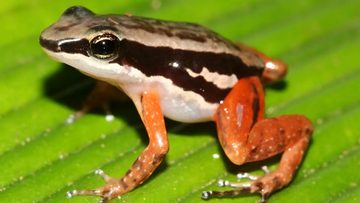
An international team led by Milan Veselý from the Department of Zoology at the Faculty of Science of Palacký University Olomouc described six new species of frogs of the genus Colostethus, in the family Dendrobatidae. The number of described species in the genus thus rose from 11 to 17.[1][2] The species were named Colostethus bocatoro, C. donosensis, C. kuara, C. portobelensis, C. sanblasensis and C. chucantiensis after the areas where they occur.[2]
Research method
The frogs in Panama had long been classified as Colostethus pratti, a species originally described from Colombia. Genetic analyses, a comparison of physical features and the calls of the males showed that they belong to several separate evolutionary lineages related to another species of the genus. According to Veselý, the species look alike, but their evolutionary history differs. The most reliable distinguishing feature was the call of the males, which differs in length, cadence, frequency and number of notes.[1][2]
According to Veselý, the aim was not only to extend the list of species but to clarify the evolutionary history of the group, which is tied to the formation of the Isthmus of Panama. All six species have a limited range, and some populations live only in small areas, which makes them sensitive to changes in the environment.[1][2]