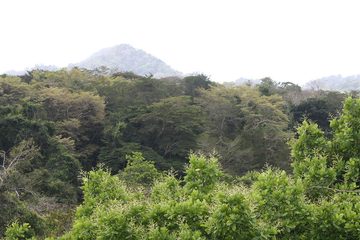
An international team led by Milan Veselý of the Department of Zoology at the Faculty of Science of Palacký University Olomouc described six previously unknown frog species of the poison dart frog family. All belong to the genus Colostethus and live in Panama. The Czech News Agency published a report on the research results on 12 November 2026, based on a statement from the university.[1][2][3]
The new species
The authors named the new species Colostethus bocatoro, Colostethus donosensis, Colostethus kuara, Colostethus portobelensis, Colostethus sanblasensis and Colostethus chucantiensis, after the areas where they occur.[2] Unlike related brightly coloured frogs, the genus Colostethus consists mostly of inconspicuously coloured species.[1][3] According to doctoral student Tadeáš Venkrbec of the Department of Zoology, the number of scientifically described species in the genus rose from 11 to 17.[1][2]
Research
The Panamanian frogs had long been classified as the species Colostethus pratti, which was originally described from Colombia. Experts, however, doubted for several decades whether they really belonged to it. Genetic analyses showed that they are not a single widespread species but several separate evolutionary lineages related to another species of the genus. The difference was also confirmed by a comparison of body features and of the males' calls.[1][2]
The calls of the males proved to be one of the most reliable distinguishing features. Their chirping sounds differ in length, rate, frequency and number of notes.[1][2] The material for the description was gathered by the scientists on several expeditions to remote and hard-to-reach areas of Panama.[2]
Distribution and threats
According to the experts, all six species have a limited range. Some populations occupy only small areas and are therefore sensitive to environmental change, Milan Veselý said. The authors of the study point out that four of the six species meet the criteria for listing as threatened.[1][3] According to Veselý, the aim was not only to extend the list of known species but to clarify the evolution of this group of amphibians, which is linked to the geological formation of the Isthmus of Panama. He also said that the tropical forests of Central America probably hide further, still unknown amphibian species.[1][2]
Sources
- Ekolist.cz — 12 November 2026
- Novinky.cz — 12 November 2026
- Deník: Olomoucký kraj — 12 November 2026