At the congress of the Czech Medical Chamber (ČLK) in Brno, the chamber pointed out that it has records of dozens of cases in which people who are not its members, and therefore have no authorisation to practise in Czechia, work as doctors in healthcare facilities. Under the law, every doctor practising in Czechia must belong to the chamber.[1][2]
Jana Vedralová, chair of the ČLK audit committee, described the situation as a problem of the whole country, including Prague, where the chamber recorded two cases over the past week. In her view it results from staff shortages: facilities sometimes employ graduates of foreign medical schools who have not passed the approbation examination in Czechia and are until then, under Czech law, not doctors. Previously it concerned mainly border areas.[1][2]
The chamber has also come across people who unlawfully appropriated the title MUDr. According to spokesman Michal Sojka, the chamber filed a criminal complaint in such a case in the past, but the police dropped it on the grounds that no crime had been proven. The chamber cannot penalise non-members and passes tip-offs to regional offices, whose procedure differs, according to Vedralová. It advises patients to check a doctor in the list of members on the chamber's website.[1][2]
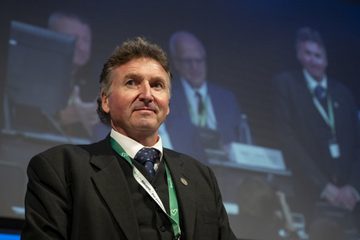
ČLK President Milan Kubek said at the opening of the congress that the shortage of young doctors in the regions is caused, among other things, by ineffective financial incentives, weak secondary education and the lack of student placements outside university hospitals. According to a study commissioned by the chamber, incentives do not solve the situation in the regions in the long term because they tend to be short-term.[1]
Milan Kubek on the shortage of doctors in the regions
Kubek said: “Any financial incentives do not work very well, because they are mostly only short-term.” In his view it is easier to motivate people who grew up in a region to return. The level of secondary schooling in many regions, he said, prevents local graduates from getting into medical faculties; he has already discussed the problem with the regional governors.[3][4]
Kubek also said that the final year of medical faculties should be purely practical and take place in regional facilities, and that trainers should have time for preparing specialist examinations within working hours and be paid for the work. In the planned healthcare reform the chamber wants to push for a two-stage specialist examination system modelled on general practitioners, with a first examination after three years of practice.[3]
The agenda of the two-day congress included the election of a vice-president of the chamber. The congress was due to end on Sunday, 22 November 2026, with legal updates, amendments to professional regulations and the congress resolution.[3]
Sources
- ČTK / České noviny — 21 November 2026
- Novinky.cz — 21 November 2026
- ČTK / České noviny — 21 November 2026
- iDNES.cz — 21 November 2026